
Catch and Release
Sep 29, 2010 I Fishing Gear and Techniques, Fishing Tips.
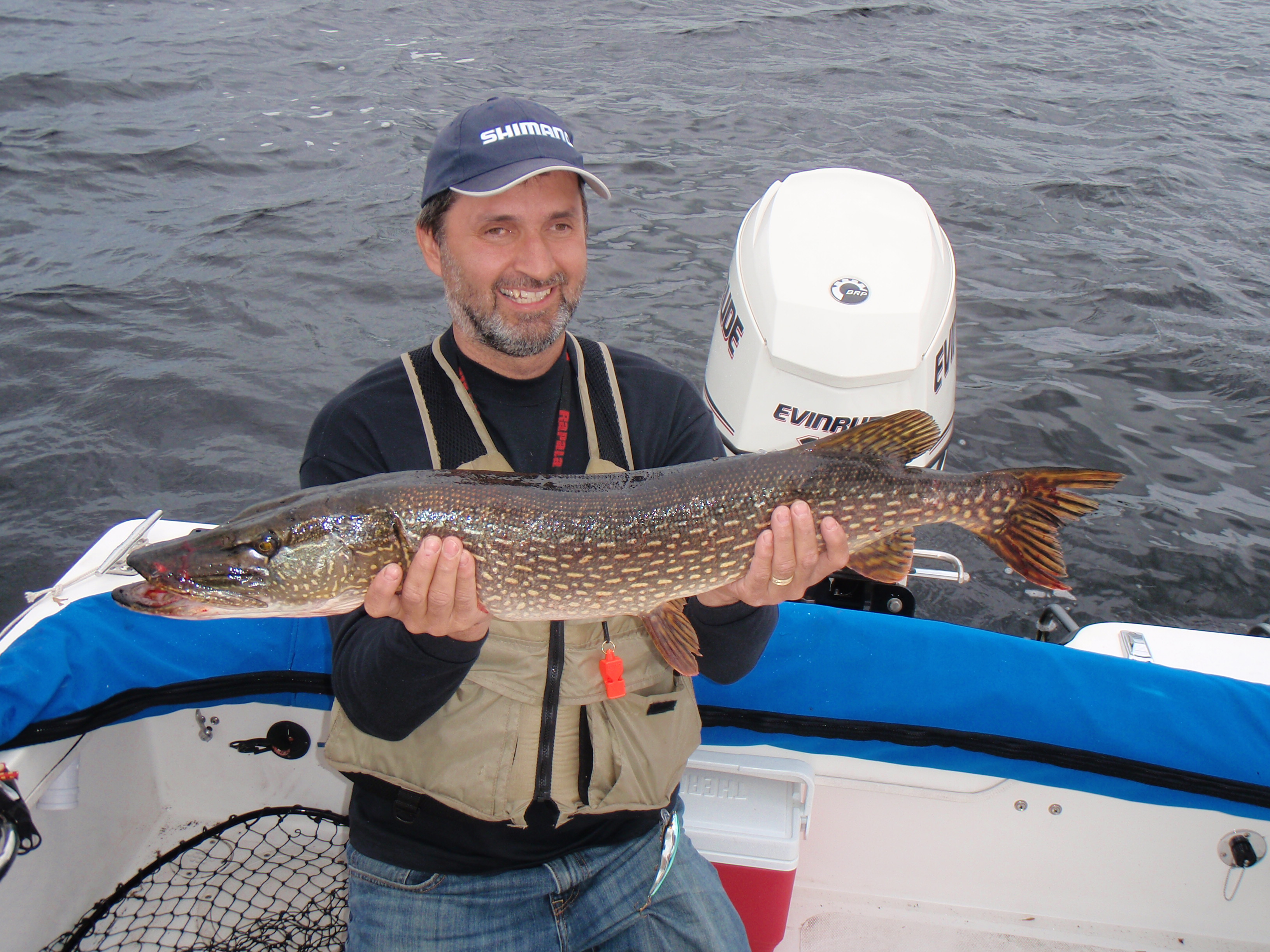
(Photograph of Lawrence with a 36” Northern Pike)
Thanks to inexpensive digital cameras now on the market, the term “catch and release” has been expanded to include “photograph”. In fact, with several quality photographs and measurements of both length and girth, it’s now possible to have exact 3-dimention replicas created of your prize catch, which many believe to be more lifelike than the traditional taxidermy using the actual skin of the fish. For those more cost-conscious, memorative plaques are also an option with companies like “Sportsman Trophy Plaque”
http://sportsmantrophy.ca/
specializing in recording the facts, photos and significance of the moment on one wall-mountable plaque.
Catch, photograph and release, or some like to refer to as CPR, has as its goal the release of fish into their environment so they might continue to grow and reproduce for years to come. Many fishers will still keep several smaller non-breeding fish for table-fair, releasing the larger spawners that are less palatable than younger fish and possess increased levels of accumulated tasteless toxins. Removal of smaller fish also reduces demand for nutrients allowing remaining stocks to grow larger faster.
Where as survival of fish released back into the water is the goal of CPR, avoiding injury to both fish and fisher is also of key concern. Odds of survival can be greatly enhanced for fish if they spend as little time as possible with their head out of water. Think of it as holding your own head underwater — at some point you run out of oxygen.
To facilitate quick release many fishers have taken to changing out treble hooks for singles, pinching down barbs or purchasing hooks with reduced barbs, or using circle hooks which are designed not to catch in the gullet of a fish but instead lodge themselves in the corner of the jaw. Pay close attention when selecting circle hooks however, as circle hooks that have an off-set point are just as likely to become deep hooked as a J-style hook.
Having proper tools on-board is also a must. I always carry needle-nose pliers that are appropriate for the fish being caught, and my pliers always have cutters that I use to snip those hooks that if removed would cause significant injury. For larger fish and hook-sizes, I carry specific cutters capable of doing the job. It’s far better to cut a hook and allow the smaller remaining hook piece to fall out over time than it is to wrestle a seriously imbedded hook out of a fish’s mouth.
A number of companies produce spreaders or grippers, such as the BogaGrip,
http://www.eastabogatackle.com/
for opening and stabilizing the mouths of uncooperative fish unwilling to relinquish their perceived meal. These grips grasp the lower jaw of the fish allowing the fisher to keep the fish from thrashing as hooks are removed or cut and measurements taken. It’s not recommended however, to lift large fish with such devices unless you plan to keep them for a meal as the innards of fish were never intended to be suspended vertically out of water. In fact, with larger fish you always want to provide support to the abdominal area or belly to ensure vital organs don’t shift when fish are removed from their relatively weightless underwater environment.
Overly tiring fish resulting from the use of under-sized fishing equipment or unproductive approaches of playing fish into the net is also problematic. If you give a fish a chance to work up a head of steam, getting it boat-side will take longer. Avoid becoming involved with “tractor-pulls” with fish, and instead use the length of your rod and boat position to keep fish off-balance. By exerting significant pressure perpendicular to the fish it’s possible to over-whelm the fish causing it to entre a temporary state of lactic shock, as oppose to allowing the fish to clear out the lactic acid from its muscles by increasing blood circulation and oxygenation, and only then eventually experience muscle fatigue. Exhausted fish take far longer to recover and are vulnerable to predators.
Nets come in many sizes and materials. Use a net that is adequate for the job. Fish in nets that are too small or which have to large of a weave can cause injury by damaging fins. After the hook has been removed or cut, and prior to the photograph being taken, allow the fish to rest inside the net in the water with the head submerged. Where as measuring the length often requires that the fish be removed from the net, girth dimensions can be acquired in the net, as well as the fish’s weight. Simply subtract the weight of the empty net after the fish is released.
Fish possess a protective slime coating on their bodies. Avoid handling fish with dry hands or placing fish on carpets or dry surfaces. More fishers are using unhooking mats that can be wetted prior to the fish being placed on the mat, and which prevent the fish from injuring itself if a struggle recommences.
Using gloves can assist with speedy fish handling. Not worrying about injuries to the hands allows the handler to move quicker. Filleting gloves such as those produced by Rapala can make fish handling a breeze, and for larger toothier fish, Frawbill markets a glove that allows fishers to place thumbs inside mouths. Remember to wet your gloves prior to handling the fish to avoid removal of their protective slime.
Fish being released after the struggle and hook removal often require time in the water prior to being let go. Hold the fish still until it regains strength as made evident by the fish thrusting clear with a powerful kick of its tail. Don’t move the fish back and forth as this prevents the fish from drawing in water with its mouth and then passing it out over the gills.
Live wells can serve as safe environments for fish to regain their strength. Be sure your water is well oxygenated and a good temperature. Ice can be introduced to more closely replicate the water temperatures of the depths from which fish are caught as oppose to the surface water drawn into the livewell by the circulation pump. Fish restoratives can also be added to livewell water to bump up oxygen levels.
Finally, a quick word about hyperboyancy. Certain fish species are unable to acclimatize themselves rapidly to sudden pressure changes. Like scuba divers, fish such as Northern Pike, Walleye, Bass, and most pan fish will develop hyper-extended swim bladders made evident by bulging of the eyes, red coloration around the gills and fins, and a swollen appearance in the throat or just behind the pectoral fins. Some fishers have adopted the use of syringes to release excess pressure, but there’s little scientific evidence whether or not nitrogen is released into the blood stream causing brain and nerve damage. Where as Trout and Salmon can burp out excess gas as they are brought to the surface, avoid fishing for other species in depths over 30 feet. If a fish is caught in deeper water try to release the fish as quick as possible by “torpedoing” the fish into the water increasing its odds of reaching more comfortable depths faster before the bladder expands making submerging next to impossible.
One last note, as a fisher without sight I’m often asked how I know what kind of fish I’ve hooked. I generally know the species of fish at the end of my line by the way it’s fighting. However, once I have a fish next to the boat, if I’m not going to use the net, I place my rod’s butt on the floor of the boat with the tip extended over the side. I slacken off the drag somewhat if the fish seems powerful enough to break my rod should it suddenly lunge. I then slide my hand down the line until I locate the lure, hook, or mouth of the fish. I have my hand fisted as not to slide fingers inadvertently into the mouth of a toothy critter or the point of a hook. Once I’ve determined where the head is located, I use my other hand to touch the fish to determine the type of fish, and then cradle the fish below the belly just behind the gills, and lift. If the fish is of a significant size, I first slip a net under the fish and verify the fish is in the net by lifting the net until I feel its weight. I then repeat the above process only now the fish is in the net.
In conclusion, I’m not against keeping the odd fish or two for dinner, as I think it makes far more sense to eat fish grown locally than it does to purchase fish flown in from half-way around the world. We’ve been eating fish for quite some time now, and scientists are coming out every day with more research findings on the beneficial effects of consuming fish. It also keeps us connected to nature, and with that connection comes a responsibility to ensure that our marine environments thrive.


Author: | Posted on 29. September 2010 at 19:02 pm | Filed in Fishing Gear and Techniques, Fishing Tips | 0 Comments


