
Blind Fishing Porta-Bote
Blind Fishing Porta-Bote is the first of its type in the world. It was conceived and developed by Lawrence Euteneier, a person without sight.
Blind Fishing Porta-Bote incorporates mainstream and assistive technologies in a 12-foot fishing boat. The technologies coupled with Lawrence Euteneier’s extensive boating and fishing experience, allow Lawrence to navigate and fish on small bodies of water on his own.
Ontario Portable Boats contributed the 12-foot Genesis IV Porta-Bote.

The boat weighs approximately 70 lbs and can be folded flat to a thickness of 4-inches. In addition to the Porta-Bote’s obvious portability advantages, the boat was selected for its proven stability and strength. Its operating characteristics, construction materials and light weight also means it can be propelled and maneuvered safely and easily using either oars or a small electric motor.

Propulsion:
A Minn Kota Maxxum 40 stern mount electric outboard was provided by Johnson Outdoors as the means of primary propulsion. The Minn Kota operates almost completely silently, and has the strength and innovative design to maneuver the boat under all conditions — from ploughing through thick weeds to running into strong winds.
Fuel Source:
The Minn Kota draws its power from a deep cycle 12V battery. The same battery is used to power the various on-board electronics. Should the Minn Kota fail or the battery die unexpectedly, oars are kept aboard for rowing.
Charge Control and Monitoring:
A talking voltmeter from the source Circuit city (catalogue 2218202) provides on-going status reports on the level of available electrical power. A 120V battery charger is used to fully charge the battery between uses, and plans are in the works to include on-board solar panels to charge the battery while underway.
Navigational Aids:
GPS
Humanware Canada is a sponsor of the Blind Fishing Boat project, and provided their talking GPS system called Trekker Breeze.
Trekker Breeze serves as the principle navigation tool. It permits the operator to navigate independently from one point of interest (POI) to another by means of audible directions spoken aloud (e.g. 18 degrees right, 138 meters). The operator is able to record specific POIs, and then navigate back to them as desired. POIs can also be downloaded over the Internet from other GPS users making it possible to go directly to known fishing hot spots.
Sonar:
Sonar sensors used in the automobile industry as reverse indicators were encorporated into the Blind Fishing boat. The sensors were provided by Trilogix. These sensors are attached to the bow of the Porta-Bote and are active at all times. Three different audible warning signals are omitted when an obstacle in the path of the Boat is detected. Slow beeps signal that an object is detected at 8 feet. Short beeps sound when obstacles are within 4 feet, and a continuous beep sounds when an object is within one foot. The audible sonar assists with both navigation and collision avoidance.
Two additional sonar devices developed for people without sight called the MiniGuide were provided by Sendero Group.
These hand-held devices have been attached to the bow of the Boat and scan ahead and to the Port and Starboard. The MiniGuides can detect obstacles up to 25 feet ahead. Each MiniGuide is connected to a small speaker located on each side of the operator to provide audio feedback in stereo; the Port speaker means obstacles ahead and to the left, and the Starboard speaker for obstacles ahead and to the right.
The operator uses an additional hand-held sonar device called K-sonar. The device was developed for people without sight, and provided for use in the project by Bay Advanced Technologies. The K-sonar unit allows the operator to scan the environment 360 degrees to assist with navigating around obstacles such as docks, rafts, and other boats.
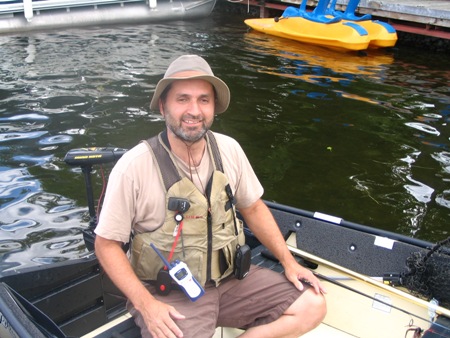
Lawrence in the back of the Porta-Bote
Talking Digital Compass:
A Robotron Columbus Talking Compass manufactured in Australia, serves both as a directional indicator when the boat is stationary, and as a back-up navigation aid. Its primary purpose is to provide feedback when the boat is not in motion. While GPS provides geo-specific information all the time, it can only provide directional (compass heading) information when the boat is moving.
Depth Sounder:
Under the right conditions, the depth sounder will also be able to alert the operator to significant bottom structure in which fish may be residing. The depth finder also alerts the operator to approaching shallow water that the operator may not wish to traverse.
Locator Tags:
Locator tags are temporarily affixed to various stationary objects such as the doc and marker boys and rafts. The operator activates these audible tags with a wireless remote transmitter when the operator is within 25 feet. The tags then omit an audible beeping sound until the operator sends a second signal to the tag via the transmitter.
Communications:
Two VHF hand-held marine radios provided by “The Chandlery” are used for 2-way communications between the operator and the assigned spotter on shore. The radios are also used to listen to weather reports and the emergency channel. The radios allow for monitoring of three different frequencies at once. A cellular phone serves as backup and is stored in waterproof packaging.
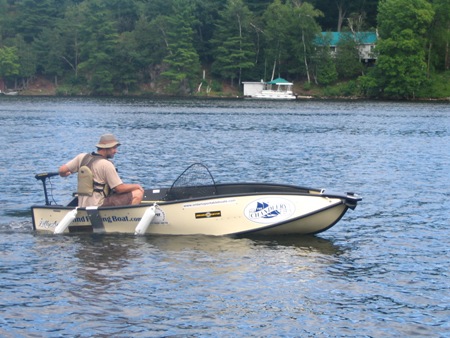
On the open water in the Porta-Bote
Emergency Equipment:
A small portable air horn, flairs and flashlight are carried for use in signaling for assistance, along with an anchor, bailing bucket and first aid kit. The operator and any accompanying passenger’s ware an inflatable personal flotation device at all times.
Additional flotation seats and night running and anchor lights are also kept on-board along with an 8-foot telescopic doc hook and two oars. Once again, The Chandlery was instrumental in ensuring that the Boat is properly equipped.


Author: | Posted on 28. May 2007 at 18:40 pm | Filed in | 0 Comments


